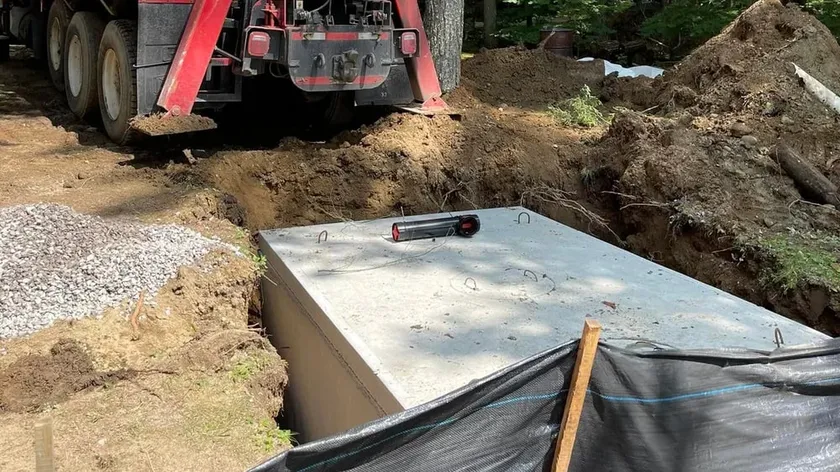
When a house with a septic system is sold in Maine, the seller has to disclose what they know about the system, and the buyer has to have it inspected only if it sits in the shoreland zone. Everywhere else, state law does not require one. This guide covers the disclosure, the shoreland inspection law and its exceptions, what an inspection checks and what it cannot tell anyone, and what happens when a system has failed partway through a sale. Replacing failed systems for home sales is how we got into septic work, and we still do it.
Does Maine Require a Septic Inspection to Sell a House?
Only in the shoreland zone. For property outside it, Maine’s septic rules say no disposal system inspection “is required by Maine statute.”
Inside the zone, state law requires the buyer to have the system inspected before the purchase, by an inspector the state certifies. The shoreland zone is the land within 250 feet of a great pond, river, or salt water, and within 75 feet of a stream; our lakefront septic guide covers exactly where it runs.
Outside the zone, a buyer can still order an inspection, and the inspector does not have to be state certified. The state recommends a certified inspector and its inspection standards anyway, as “beneficial to both the buyer and seller.”
What Does a Seller Have to Disclose About a Septic System?
Unless the sale is one of the exempt kinds, a seller of a house in Maine owes the buyer a property disclosure statement, and when the house has a private waste disposal system, the statement has to cover:
- the type of system
- the size and type of the tank, and where it is
- when the tank was installed, and any malfunctions of it
- where the leach field is, when it was installed, and any malfunctions of it
- the date of the most recent servicing, and the name of the contractor who services the system
The exemptions include transfers by court order or foreclosure, transfers through an estate, and transfers between co-owners or spouses, among others. On shoreland property, the seller also owes the buyer a written statement on whether the system has malfunctioned in the 180 days before the transfer.
The system’s HHE-200, the design and permit application kept at the town office, records what was designed and permitted, where, and for how many bedrooms. Older systems may not have one on file. The main septic guide covers how to get a copy.
What Does Maine’s Shoreland Septic Inspection Law Require?
An inspection by a state-certified inspector before the purchase. 30-A MRSA §4216 puts the requirement on the buyer, for any property with a septic system in the shoreland zone.
Two deadlines come with it. If weather makes an inspection impossible before the sale, it has to be done within nine months after the transfer. If the inspection finds the system malfunctioning, the system has to be repaired or replaced within one year after the transfer.
Under the state’s rules, the results do not stay with the buyer and seller. The inspector completes the summary report on a state form, sends a copy to the town within 60 days, and reports a malfunctioning shoreland system to the state and the town’s Local Plumbing Inspector within 72 hours.
When Can the Shoreland Inspection Be Skipped?
In three cases, all in the same statute. A system installed under permit within three years before the closing is exempt. So is a sale where the seller has a certified inspection report from the past three years and gives the results to the buyer.
The third is the buyer’s choice: the inspection is not required if the buyer certifies to the town’s Local Plumbing Inspector that they will replace the system within a year of the transfer.
Who Can Inspect a Septic System in Maine?
For a shoreland sale, only an inspector certified by the state. Maine CDC certifies them and publishes the list. Certification takes an approved national certification and a passing score on the state’s open-book exam on the septic rules, and it lasts three years. Licensed Site Evaluators can be certified on request with no further exam.
Outside the shoreland zone, no certification is required, because state law requires no inspection there. The state’s rules still recommend a certified inspector.
What Does a Septic Inspection Check?
The paperwork first, then every part of the system from the house to the field. Under the state’s inspection standards, the inspector starts with the HHE-200, and what is found in the ground has to match it.
The house has to match it too. The standards give their own example: a five-bedroom house should not be served by a system permitted for three bedrooms, and the inspector has to note a mismatch like that prominently on the report. A bedroom added without a septic review shows up here; the main septic guide covers why.
The inspection covers the plumbing inside the house, the tank and its filters and baffles, the distribution box and piping, the field, and any pumps, alarms, or treatment units. The distance from the system to every drinking water well on the property gets measured and written down. In the shoreland zone, the inspection has to include a camera.
The inspector does not have to dig deep. Inspectors are not required to uncover anything more than 24 inches below grade, or anything where hand digging is unreasonable, and the rule gives frozen ground as an example. In those cases, the person who ordered the inspection has to get the components uncovered.
What Can’t a Septic Inspection Tell a Buyer?
How long the system will keep working. The state’s rules describe an inspection as an evaluation of the system’s current condition, and say it “is not a guarantee of system performance or functionality at any time in the future.” The state does not endorse or certify the results.
The standards also tell inspectors to stay inside what they know: an inspector “should limit their inspection to the types of systems and components they are familiar with and can accurately evaluate.” The reason is in the same paragraph: many kinds of systems, proprietary devices, and treatment units are in use now, an Eljen field among them.
What Counts as a Failed Septic System in Maine?
The state defines it by four signs. Under Maine’s rules, a system is malfunctioning when there is:
- wastewater or septic tank effluent ponding or breaking out onto the ground
- wastewater seeping into below-ground parts of a building
- sewage backing up into the house, when the cause is not a blockage in the house’s own plumbing
- contamination of nearby wells or water bodies
For the shoreland inspection law, the statute limits the signs of a malfunction to the ones in that definition. A system that would not meet today’s rules falls in a separate category, a nonconforming system, and is not a failed system for that reason alone.
What Happens When the System Fails During a Sale?
It has to be replaced or repaired, on a deadline. Maine’s rules require a malfunctioning system to be replaced within the time the Local Plumbing Inspector orders, or repaired where the rules allow. On a shoreland sale, a malfunction found by the transfer inspection has to be fixed within one year after the transfer.
A replacement goes through the same steps as a new system: a Site Evaluator’s soil test and design, the HHE-200, the town’s permit, and an inspected installation, laid out in the main septic guide. The design follows the replacement-system rules, which allow reduced setbacks where a lot cannot fit a new system’s, though the Site Evaluator has to try for the new-system standards first.
A failed leach field can stop a home sale, so we started partnering with realtors to replace those systems on the sale’s timeline. Failed systems do not wait for spring, and we handle those replacements year-round, with the extra steps a winter install needs.
…incredibly accommodating to the time constraints on my listing. They replaced the leach field quickly and efficiently, keeping everything on track and stress-free.
Septic Replacements for Home Sales in Central Maine
Mariner Construction replaces failed septic systems for home sales from Mount Vernon, across the Augusta area and the Belgrade Lakes region. We install Eljen, Infiltrator, and concrete chamber systems; Justin is a certified Eljen installer, and the company is DEP certified for shoreland work. The rules for lakefront and camp lots are in our lakefront septic guide, and the service page carries the full scope and the town list: septic system installation.
If a sale is waiting on a septic system, use the estimate form below to tell us about the property and the timeline.