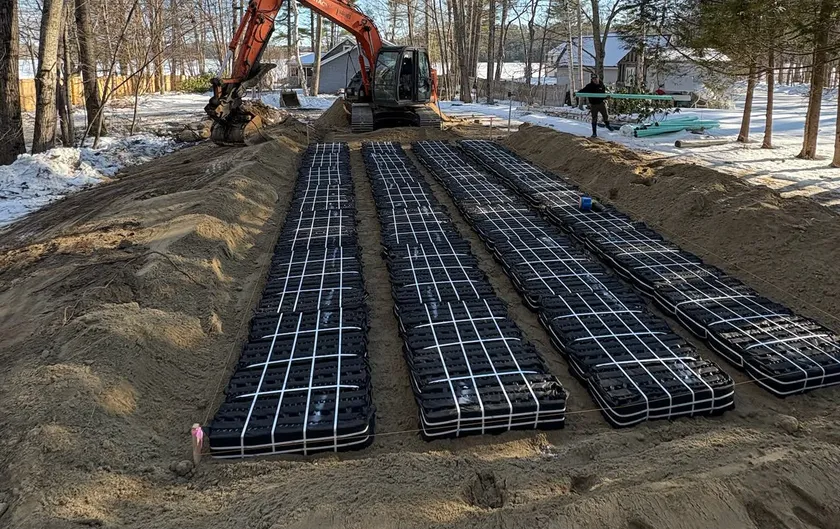
An Eljen system is a septic leach field built from manufactured modules set in a bed of specified sand, in place of the stone and pipe of a conventional field. Eljen designed its GSF, short for Geotextile Sand Filter, to treat effluent before it reaches the native soil, and it is typically used where there is not enough room for a conventional field. This guide covers how it works, how it is built, what can and cannot go on top of one, and how to keep it working.
Why We Became Eljen Certified
We became Eljen certified because we see a lot of Eljens going in on tough lots, where a larger, traditional stone-and-pipe field just doesn’t work. An Eljen takes about a quarter of the footprint. It can be shaped to fit a tough area, and it can be stepped down to fit into a hillside.
What Is an Eljen GSF?
A leach field made of fabric-wrapped plastic modules in a bed of specified sand. Eljen describes each GSF module as a geotextile fabric and a plastic core that “work together to provide vertical surface area and oxygen transfer.” The modules are four feet long and seven inches tall, in two- and three-foot widths.
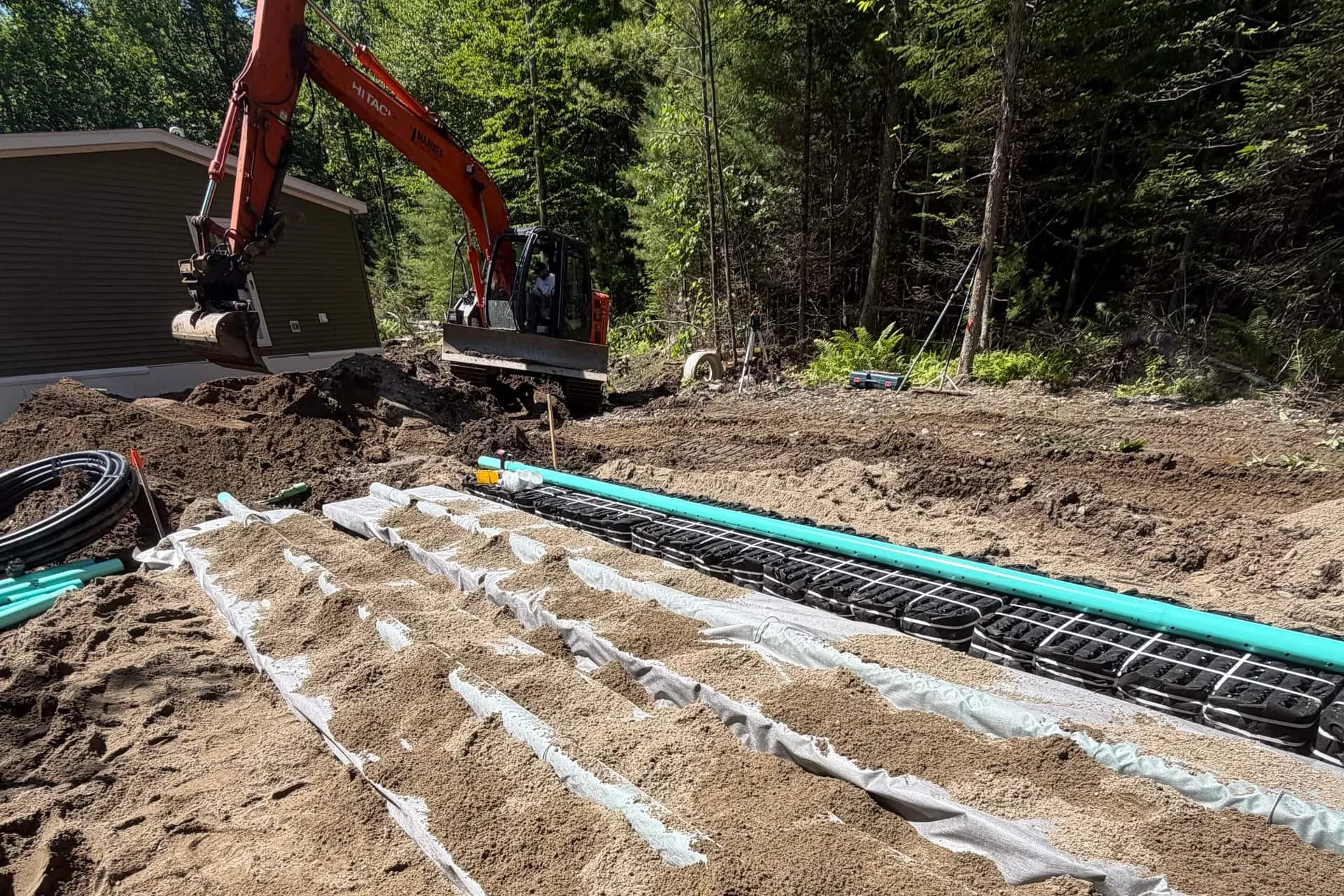
The modules sit in rows on a layer of the sand, with a perforated pipe centered on top of each row to spread septic tank effluent over and into the modules. A cover fabric goes over each row; Eljen supplies it and allows no substitutes. More specified sand goes along both sides of the modules and at the ends of each row.
Maine’s septic rules call a product like this a proprietary device: one used in a disposal field in place of a bed of stone and distribution pipe.
How Is an Eljen Different From a Stone-and-Pipe Field?
The difference is where the treatment happens. In an Eljen, the bacteria that treat effluent grow on the module’s fabric, fed with air through open channels in the module, and Eljen says the design takes “the burden of treatment and biomat development off of the native soil.” Effluent then drips through the sand into the native soil, which Eljen describes as providing the final filtration.
Eljen’s claim is that the soil absorbs effluent treated this way more easily, “resulting in a better-performing system in a smaller area than other systems.” It says its products are used “typically when there is not enough space for a conventional stone and pipe system, or if a certain treatment level is needed.”
Field size still comes from the rules. In Eljen’s own words, the area “depends on how many bedrooms your home has, state or local regulations, and site characteristics,” and the Site Evaluator decides whether a lot gets an Eljen at all, as the main septic guide explains.
Why Does an Eljen Field Need Specified Sand?
Because the sand is part of the treatment. Eljen says the specified sand layer “provides additional filtration, and prevents saturated conditions,” and that it protects the native soil from compaction.
Eljen requires ASTM C33 sand with less than 10 percent passing a #100 sieve and less than 5 percent passing a #200 sieve for every GSF, and tells installers to get a sieve analysis from their supplier to confirm it.
An Eljen field needs six inches of specified sand spread and leveled under the modules. In winter we only spread that sand when there is time the same day to set the modules at grade and backfill around them, so it cannot freeze before it is compacted; the main septic guide covers winter installs.
What Can Go On Top of an Eljen Field?
Mowed grass, and nothing else. Eljen’s homeowner manual says not to drive or park over any part of a septic system, and that “the area over the system should be left undisturbed with only a mowed grass cover.”
Eljens are especially sensitive to traffic. Where a system has to sit under a driveway, we install concrete chambers, which are built to carry load.
Eljen warns that roots from nearby trees or shrubs can clog or damage the system, and root intrusion is the number one issue we see on field systems. The best prevention is cutting all trees at least twenty feet back around the field; near a lake, the town’s shoreland rules on tree cutting apply as well.
How Often Does an Eljen System Need Pumping?
At least every three years, by Eljen’s standard. Its homeowner manual says to “clean your filter and pump your tank at a minimum of every 3 years.” Maine’s general guidance for septic tanks is every two to five years, depending on how heavily the system is used, and every year for a house with a garbage disposal.
The filter is what protects the modules. An Eljen system includes an effluent filter at the tank outlet or just after the tank, which keeps particles larger than about 1/16 inch out of the modules. Eljen says the filter slowly restricts flow over two to three years as a reminder that the tank needs service, and that it should be cleaned when the tank is pumped.
A field should only ever see liquid. Solids reach it when a tank goes too long between pumpings or when the outlet filter or baffle fails, and they plug the field.
Eljen also says septic additives have “not been shown to be of significant value,” and that a garbage disposal should only be used if the system was designed for one under Eljen’s guidelines.
What Are the Signs of a Failing Eljen System?
The same as any septic system. Eljen’s manual lists slow-draining toilets or fixtures, sewage backing up into the house, sewage odors near the field or tank, and sewage breaking out onto the lawn. Two of those, a backup and a breakout, are also in Maine’s legal definition of a failed system.
Eljen also notes that in winter, effluent can freeze in the force main or distribution box of a pumped system that has gone unused long enough, and block the flow.
Eljen, Infiltrator, or Concrete Chambers?
The Site Evaluator specifies the system from the soil and the space, and we install all three. Infiltrator chambers are an alternative to a traditional stone-and-pipe field. Concrete chambers carry load, so they go where a system has to sit under a driveway or in a space nothing else fits. The Eljen GSF treats effluent in its modules and sand before the soil receives it, and is typically used where there is not enough room for a conventional field.
Eljen Systems in Central Maine
Justin Lovely is a certified Eljen installer, and Mariner Construction installs Eljen, Infiltrator, and concrete chamber systems from Mount Vernon, across the Augusta area and the Belgrade Lakes region. The rules for lakefront and camp lots are in our lakefront septic guide, the permit process is in Getting a Septic System in Maine, and the service page has the scope and town list: septic system installation.
If you are planning an Eljen system, or think a lot may need one, use the estimate form below to tell us about the site.